


Policy
What Work Does Generative AI Do?
Essays SEP 8, 2026
By: Alexander Bick, Adam Blandin, David Deming, Tyler Schumacher
AI, Tech & Energy
Labor, Wages & Worker Power
 Browse All Resources
DEC 4, 2020

This is a post we publish each Friday with links to articles that touch on economic inequality and growth. The first section is a round-up of what Equitable Growth published this week and the second is relevant and interesting articles we’re highlighting from elsewhere. We won’t be the first to share these articles, but we hope by taking a look back at the whole week, we can put them in context.
This week, Equitable Growth launched our 2021 Request for Proposals. Since our founding, we have focused on deepening our understanding of how inequality affects economic growth and stability by supporting research that investigates these topics from a diverse range of perspectives in economics and the social sciences. Our RFP is organized around four main channels of economic growth: human capital and well-being, the labor market, macroeconomics and inequality, and market structure. And this year, we are particularly interested in research that looks at the consequences of structural racism, as well as climate change, on these four areas. Read more about our RFP and the types of research we aim to fund, as well as details about who is eligible, how to apply, and upcoming deadlines.
As millions of workers continue to be out of work as a result of the coronavirus pandemic and recession, many have relied upon their states’ Unemployment Insurance benefits to get through the worst of the economic downturn. Earlier this year, the U.S. Congress passed a program called Pandemic Emergency Unemployment Compensation, which provides an additional 13 weeks of benefits for those who have used up the standard 26 weeks in their states. But the program is set to expire at the end of this month. Alix Gould-Werth explains the results of a recent study that looks at the benefits of expanding unemployment benefits to workers, firms, and the economy. The study uses data from previous recessions, with implications for the current one: The research finds that when workers have access to Unemployment Insurance that provides the resources to cover their basic living expenses, they are able to take the time to find a job that fits their skillset and meets their needs, both financially and in terms of working conditions, rather than taking the first job they find. This not only benefits workers and their families but also allows firms to fill openings with the best-suited candidates for their jobs, increasing overall productivity—and causing positive ripple effects across the economy. The findings indicate that insufficient levels and durations of UI benefits during downturns may exacerbate inequality in the U.S. labor market, writes Gould-Werth. This is particularly disconcerting in amid the coronavirus recession.
In the United States, an individual’s income is not only determined by level of skills or education, but also by the opportunities they have to deploy those skills in jobs that value them—which often comes down to networking. This balance between what you know and who you know in opening doors for economic prosperity makes it hard to break the cycle of poverty, writes Matthew Staiger, and runs counter to the American ideal of equality of opportunity. Staiger’s recent working paper looks at individuals who work at the same employer as a parent and the effects this has on earnings and opportunities. He finds that around 7 percent of individuals work for a parent’s employer at their first job and 29 percent do so by age 30—a trend which is associated with large earnings benefits, including 31 percent higher initial income at a first job. This exacerbates existing economic and racial inequalities in the labor market, Staiger shows, with non-Black males with high-earning parents benefitting the most.
The child care industry in the United States is facing twin crises: immediate challenges as a result of the coronavirus pandemic and recession that leave child care providers and families alike struggling, and larger structural challenges that were present even before the coronavirus began to wreak havoc on the country earlier this year. Sam Abbott explains how reforms to U.S. child care policy, while a step in the right direction, would benefit from further research to ensure that proposals appropriately target the right issues. Abbott highlights three gaps in child care research: the child care experiences of children of color, low-income children, older children, and their families; the experiences and impact of providing child care through home-based providers, as opposed to center-based care; and improving job quality and support for the child care workforce and the ways in which that increased support would improve care quality. He concludes with several opportunities and suggestions for those interested in conducting further research.
Every month, the U.S. Bureau of Labor Statistics releases data on the labor market. Today, it released data for the month of November, which showed that the jobs recovery is stalling, threatening low-wage workers and workers of color in particular. Kate Bahn and Carmen Sanchez Cumming explain that despite an overall unemployment rate of 6.7 percent, it is 10.3 percent for Black workers and 8.4 percent for Latinx workers. They look at how the pandemic has affected different wages groups and why these effects are problematic for future economic growth. (You can also check out Bahn and Sanchez Cumming’s five graphs highlighting important trends in the data.)
Instead of tax cuts, let’s talk about higher wages to grow the economy, writes (opens in a new tab) The New York Times’ Editorial Board. The pervasive narrative about economic growth has largely been about tax cuts—on both sides of the political aisle—and has been so pervasive, in part, because other policy ideas have not been seriously discussed as an alternative. But increasing workers’ wages should be the priority of economic policymakers under the new administration, the Board continues (opens in a new tab). Doing so can boost economic growth, which will be badly needed amid the continuing coronavirus recession, because workers who are paid more can also spend more across the U.S. economy. Higher wages must be paired with other policies, such as strengthening the safety net, addressing structural racism, and protecting the environment, in order to ensure a minimum quality of life, the board concludes (opens in a new tab). Wage growth alone is not a silver bullet, but it is a useful organizing principle and a valuable counterweight to tax cuts in the debate on how to grow the economy and increase productivity.
The lack of additional pandemic relief from the U.S. Congress is killing people and making the pandemic worse—a scary prospect considering the current surge in coronavirus cases and COVID-19 deaths we are experiencing, writes Vox’s Anna North (opens in a new tab). She explains (opens in a new tab) the effects that Congress’ inaction is having not only on U.S. families, small businesses, and state and local governments, but also on the virus and its spread. North shows (opens in a new tab) how the expiration of various emergency programs, from expanded Unemployment Insurance to eviction moratoriums, enacted to address pandemic early on has led to heartbreaking decisions for both employers and employees, pitting the U.S. economy against public health and safety. North urges (opens in a new tab) policymakers to pass additional economic relief in order to help Americans contain the virus by staying home and sheltering in place without facing negative consequences at work.
One group of workers toiling around the clock to feed those who are lucky enough to stay home is food delivery workers. While food delivery app usage surged, the workers who are essential to these apps are struggling under worsening working conditions, reports Kimiko de Freytas-Tamura (opens in a new tab) for The New York Times. Looking at New York City in particular, Freytas-Tamura writes (opens in a new tab) that many of those who lost their jobs early on in the pandemic turned to gig work such as delivering food to users of DoorDash, Uber Eats, and GrubHub—all three of which are booming with heightened demand from people working from home. These gig workers already faced precarious conditions—from low wages to lack of benefits such as health insurance—prior to the onset of the coronavirus pandemic, and things have only gotten worse since. And not only are these often overlooked workers more vulnerable to getting the virus due to their inability to work from home and exposure to large swaths of the public; they also are facing rising crime rates in the city, including assault and bike theft. Freytas-Tamura tells the story (opens in a new tab) of several of these workers and the various struggles, fears, and challenges they are facing.
Friday figure
View FullscreenFriday figure — opens in a new tab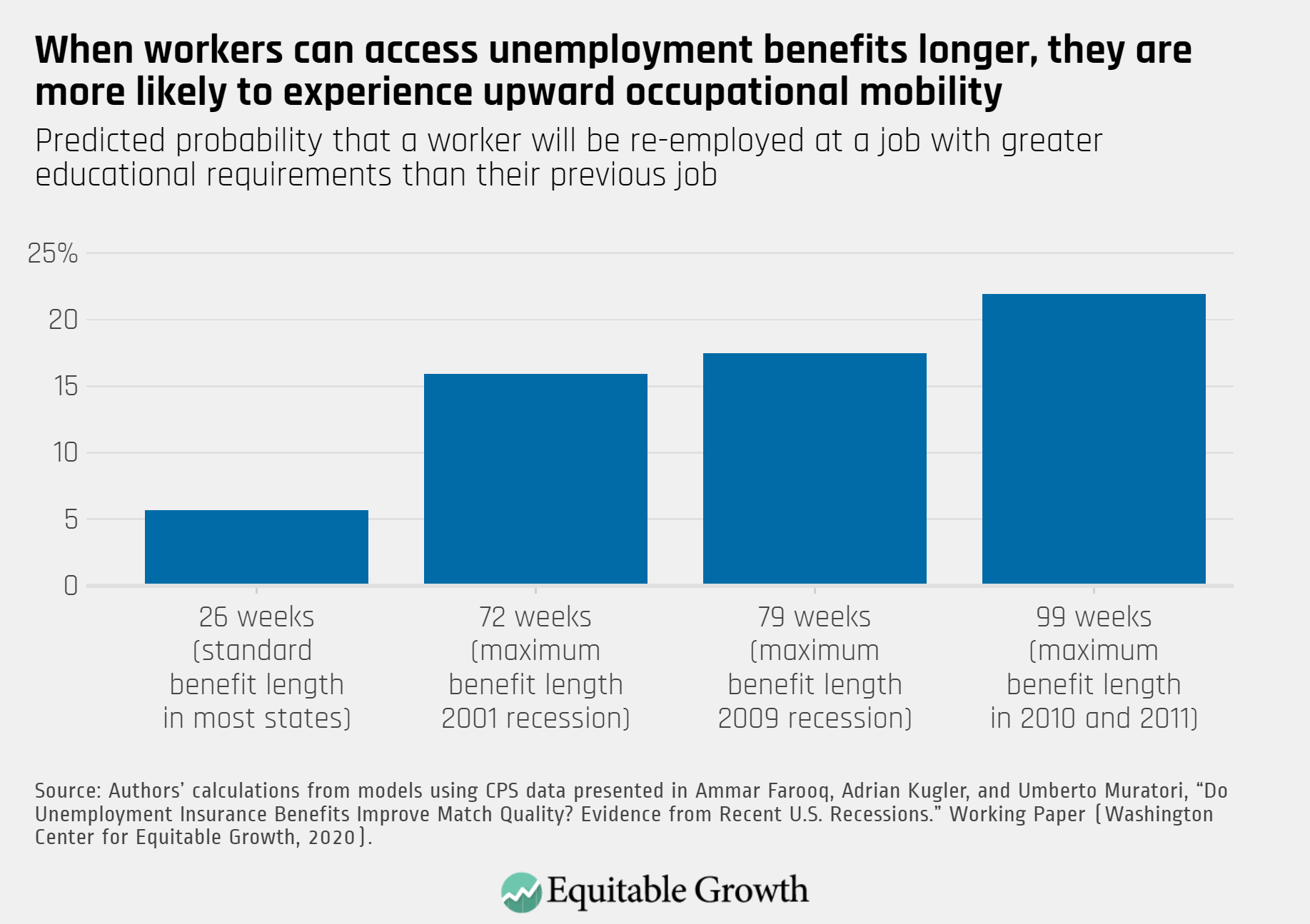
Predicted probability that a worker will be re-employed at a job with greater educational requirements than their previous job
Figure is from Equitable Growth’s “The long-run implications of extending unemployment benefits in the United States for workers, firms, and the economy” by Alix Gould-Werth.
Essays SEP 8, 2026
By: Alexander Bick, Adam Blandin, David Deming, Tyler Schumacher
Essays SEP 2, 2026
By: Megan Rivera

Essays AUG 31, 2026
By: Christopher Bangert-Drowns
Get updates on our latest research, event announcements, and policy insights delivered straight to your inbox. Stay connected with the leading voices on equitable growth.


