



Policy
What Work Does Generative AI Do?
Essays SEP 8, 2026
By: Alexander Bick, Adam Blandin, David Deming, Tyler Schumacher
AI, Tech & Energy
Labor, Wages & Worker Power
 Browse All Resources
MAY 21, 2021

This is a post we publish each Friday with links to articles that touch on economic inequality and growth. The first section is a round-up of what Equitable Growth published this week and the second is relevant and interesting articles we’re highlighting from elsewhere. We won’t be the first to share these articles, but we hope by taking a look back at the whole week, we can put them in context.
Amid increased government spending to combat the coronavirus and the ensuing recession alongside overblown fears of inflation, some policymakers are pushing for austerity and against additional public investments. But U.S. history shows that anti-austerity policies are proven to bolster and grow the U.S. economy equitably. Nic Johnson, Robert Manduca, and Chris Hong look back at three widely held anti-austerity perspectives from the early 20th century—underconsumption theory, channeling finance, and secular stagnation—that laid the groundwork for the New Deal and the post-World War II economic boom. Underconsumption theory is the idea that when workers can’t afford to buy everything they produce, it creates imbalances in the economy that are obscured by unsustainable credit and debt levels. The proponents of this idea at the time suggested channeling finance and steadying financial institutions to break the resulting vicious cycle and open wealth-building opportunities for more Americans. Lastly, secular stagnation is the theory that describes the economic condition where the number of profitable investment opportunities is not sufficient to absorb the savings in the economy. The co-authors explain how each of these three perspectives can teach us a great deal these days about growing the economy sustainably and broadly, and provide a path forward that doesn’t embrace austerity or financialization. Adhering to these perspectives, they conclude, would also work to address the rampant inequality evident across the U.S. economy and society since the 1980s.
This week, Director of Markets and Competition Policy Michael Kades submitted a statement for the record with the U.S. House Oversight and Reform Committee for a hearing on anticompetitive behaviors in the U.S. pharmaceutical industry and soaring prescription drug prices. Kades provided a summary of the anticompetitive behavior in which pharmaceutical company AbbVie (whose CEO was testifying in the hearing) has long engaged—namely, pay-for-delay patent settlements, frivolous patent litigation, and product hopping—and how Congress can act to change these market dynamics that lead to concentration and soaring profits for drug companies, and rising costs and fewer options for consumers. He recommends that Congress stop pay-for-delay settlements, which allow a company to pay its generic competitors to not release or defer the release of their product; restore the Federal Trade Commission’s disgorgement authority, depriving companies of illegal profits earned as a result of anticompetitive behavior; and deter strategic behavior that protects monopolies, such as product hopping, or the release of “new and improved” products that are not significantly different from their predecessors in order to quash generic competition. These actions would help lower prescription drug costs for consumers in the United States and protect competition in the pharmaceutical industry.
Head to Brad DeLong’s latest Worthy Reads column (opens in a new tab), where he provides summaries and analysis of recent must-read content from Equitable Growth and elsewhere.
For those anxiously reading headlines about inflation, The New York Times’ Neil Irwin (opens in a new tab) provides some reassuring advice in The Upshot blog. He proposes (opens in a new tab) asking five essential questions whose answers shine some light on the mechanisms through which the value of a dollar changes over time. He first suggests looking at whether the increases in prices for goods and services are relative or dispersed across industries and sectors and then whether the prices that are rising are likely to continue going up, to plateau, or to go back down. He then asks whether wages are also rising and whether inflation is rapid and erratic or steady. Finally, he asks whether we are actually, in fact, experiencing inflation or if it’s simply a price shift for assets and investments. Irwin breaks down (opens in a new tab) the aspects of each of these areas that could be concerning, as well as those that are not, finding ultimately that the inflation alarm bells are currently ringing prematurely (while advising readers to keep a close eye out for several warning signs).
The U.S. government should tax rich people in order to pay for its investment priorities. It’s simply the right thing to do (opens in a new tab), argues Vox’s Emily Stewart (opens in a new tab). The well-off have disproportionately benefitted from economic growth and stock market booms, particularly over the past 40-plus years as economic inequality has become pervasive in the United States. And it’s well-documented that the rich have gotten a lot richer during the coronavirus pandemic and resulting recession—and that they know how to evade taxes better than the rest of us. Stewart cautions (opens in a new tab) that changes to tax law must be robust enough to close loopholes and prevent tax avoidance from savvy filers, while also urging Congress to act. As President Joe Biden angles to get his American Jobs Plan and American Families Plan passed, taxing the rich is a fair way to pay for a lot of these important public investment policies—and they can afford it, Stewart writes (opens in a new tab). While it won’t pay for everything the Biden administration has proposed, it will work to redistribute the tax burden and reduce the inequality that has come to define the U.S. economy.
Friday figure
View FullscreenFriday figure — opens in a new tab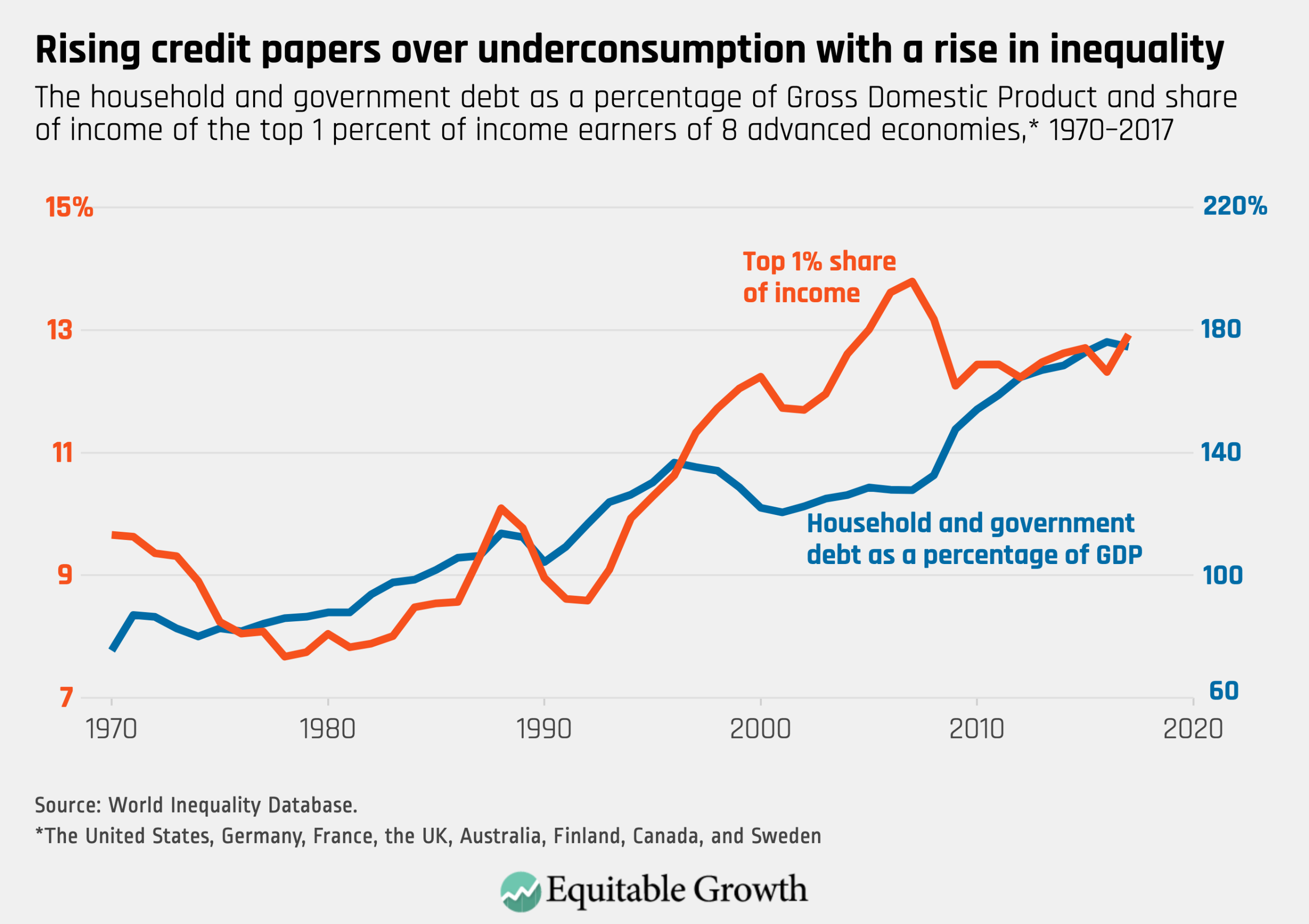
The household and government debt as a percentage of Gross Domestic Product and share of income of the top 1 percent of income earners of 8 advanced economies, * 1970-2017
Figure is from Equitable Growth’s “The American anti-austerity tradition,” by Nic Johnson, Robert Manduca, and Chris Hong.
Essays SEP 8, 2026
By: Alexander Bick, Adam Blandin, David Deming, Tyler Schumacher

Essays SEP 2, 2026
By: Megan Rivera

Essays AUG 31, 2026
By: Christopher Bangert-Drowns
Get updates on our latest research, event announcements, and policy insights delivered straight to your inbox. Stay connected with the leading voices on equitable growth.


