



Policy
What Work Does Generative AI Do?
Essays SEP 8, 2026
By: Alexander Bick, Adam Blandin, David Deming, Tyler Schumacher
AI, Tech & Energy
Labor, Wages & Worker Power
 Browse All Resources
AUG 27, 2021

This is a post we publish each Friday with links to articles that touch on economic inequality and growth. The first section is a round-up of what Equitable Growth published this week and the second is relevant and interesting articles we’re highlighting from elsewhere. We won’t be the first to share these articles, but we hope by taking a look back at the whole week, we can put them in context.
Policymakers expanded investments in critical social infrastructure after the onset of the coronavirus pandemic and ensuring recession, expanding access and funding for programs such as Unemployment Insurance and the Child Tax Credit. These expansions have helped millions of U.S. families and workers but are only temporary, meaning policymakers are now debating whether to make these measures permanent. Michael A. Schultz urges policymakers to do so, detailing his recent working paper on poverty and low-wage workers’ mobility into higher wages. His research finds that 30 percent of low-wage workers who experience poverty in the previous year move to better wages within 2 years, compared to 45 percent of low-wage workers who did not experience poverty. A significant explainer of the difference comes down to household resources—which are bolstered by programs that provide income support, buffering the effects of falling into poverty. Schultz concludes by making several policy recommendations, including permanently expanding these social infrastructure programs, removing complexity and confusion around applying for them, and providing bank accounts to every American to ensure they are able to easily receive benefits.
Research published earlier this year looks into the effect of coronavirus disruptions in family caregiving and highlights the importance of investments in care infrastructure and paid leave. Yulya Truskinovsky details the findings of her co-authored working paper, which studied the mental health effects for family caregivers of added or changed caregiving responsibilities as a result of COVID-19. Truskinovsky and her co-authors show that those who experienced such disruptions were more likely to screen positive for depression, anxiety, and loneliness than either noncaregivers or those caregivers who did not face disruptions. This, she explains, underscores the essential nature of investments in care infrastructure and programs such as paid leave to support both caregivers and workers who take on caregiving responsibilities for loved ones. These programs are all the more vital considering that the U.S. workforce is aging, and as such, family caregivers will play an increasingly central role in the nation’s healthcare system.
Equitable Growth’s 2021 policy conference, “Equitable Growth 2021: Evidence for a Stronger Economic Future,” is coming up in a few weeks. This biennial event highlights our role as a connector of the academic and policymaking communities, bringing together experts and leaders across issue areas and disciplines to discuss policy solutions for the most pressing issues facing the United States. As speakers continue to be announced for this year’s virtual meeting, Christian Edlagan, Maria Monroe, and I look back at the incredible contributions and expertise of participants from our 2019 policy conference, in this month’s installment of Expert Focus (opens in a new tab). (And click here to register (opens in a new tab) for this year’s event, on September 20 and 21.)
Unemployment Insurance benefits helped a larger share of U.S. workers during the coronavirus pandemic and ensuing recession than during the Great Recession of 2007–2009, reports (opens in a new tab) Yahoo!Money’s Denitsa Tsekova (opens in a new tab). A study by the Federal Reserve Board finds that 52 percent of UI recipients whose 2020 earnings dropped by 10 percent or more received to buffer their income loss, compared to 19 percent of recipients in 2009. Considering that around the same percentage of workers lost more than 10 percent of their income in 2020 and in the Great Recession—around 33 percent—the financial outcomes for workers during this economic downturn were much better thanks to the coronavirus aid packages that expanded unemployment benefits and provided stimulus payments. Tsekova details (opens in a new tab) the differences in UI benefits between the coronavirus recession and the Great Recession and explains how the pandemic response was more supportive for those workers in need.
The climate crisis is increasingly at risk of becoming an economic crisis, writes (opens in a new tab) The New York Times’ Neil Irwin (opens in a new tab). With rising global temperatures comes added economic and financial problems alongside humanitarian crises. The current Fed Chair Jerome Powell has taken a more moderate approach to dealing with climate change, much to activists’ dismay. But, Irwin explains (opens in a new tab), perhaps one of the most important things the Fed can do to fight climate change is to maintain a stable, strong economy. Irwin details the research behind public opinion, climate politics, and the economy, explaining (opens in a new tab) that if the U.S. economy is steady then there may be more political appetite and opportunity for bold climate action.
Friday figure
View FullscreenFriday figure — opens in a new tab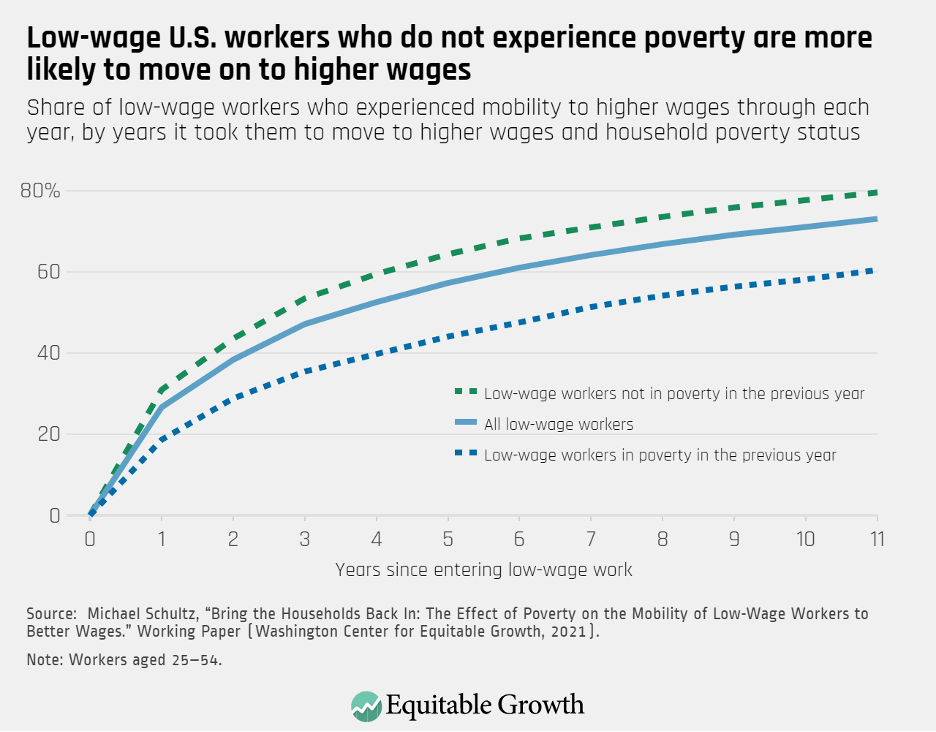
Share of low-wage workers who experienced mobility to higher wages through each year, by years it took them to move to higher wages and household poverty status
Figure is from Equitable Growth’s “Income support programs boost earnings for low-wage workers by reducing household poverty in the United States,” by Michael A. Schultz.
Essays SEP 8, 2026
By: Alexander Bick, Adam Blandin, David Deming, Tyler Schumacher

Essays SEP 2, 2026
By: Megan Rivera

Essays AUG 31, 2026
By: Christopher Bangert-Drowns
Get updates on our latest research, event announcements, and policy insights delivered straight to your inbox. Stay connected with the leading voices on equitable growth.


