



Policy
What Work Does Generative AI Do?
Essays SEP 8, 2026
By: Alexander Bick, Adam Blandin, David Deming, Tyler Schumacher
AI, Tech & Energy
Labor, Wages & Worker Power
 Browse All Resources
MAY 9, 2019

As the U.S. economy slowly but steadily recovered from the Great Recession beginning in 2009, Gross Domestic Product grew, employment rose, and the unemployment rate declined. These were all consistent with an economic recovery, but one very important metric has not caught up. Wages, seemingly defying the laws of labor supply and demand, remained essentially flat. The economy was growing, demand for workers was rising faster than the supply, yet the nominal price of their labor was not increasing any faster than inflation. As a result, the additional income produced by a growing economy was going not to workers, but to capital—investors and employers. And while real wage growth has begun to pick up in recent months, it is still below target (opens in a new tab) for a tight labor market.
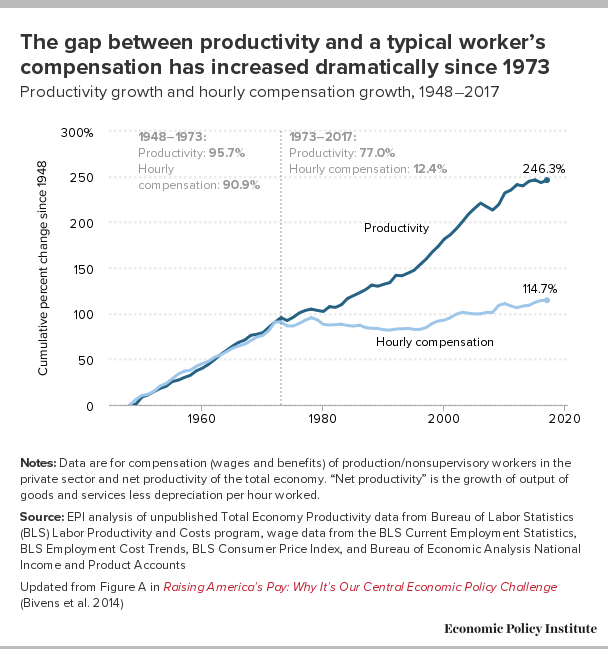
In the post-World War II era, as productivity rose, wages for U.S. workers went right up with it. Workers enjoyed the fruits of their hard work, made ever more efficient and productive by improving technology. But in the 1970s, as the Economic Policy Institute has demonstrated (opens in a new tab), wages and productivity became decoupled. As the EPI figures show, productivity has risen fairly steadily since then, yet wages have stagnated.
Over time, one theory—which was advanced about the flattening of wages and today is almost accepted wisdom—was that wages were rising at a healthy clip for skilled workers; it was only relatively low-skilled workers for whom wages were flat. There were higher-skilled jobs available, the theory went, but not enough workers with those skills. Hence, the supposed “skills gap” between supply and demand for skills.
But if the problem of growing wage inequality were primarily a problem of skills (opens in a new tab), then to make wages grow, policymakers would need to reduce the skills gap. The way to do that, so the argument still goes, is for workers to become better educated and better trained by getting higher degrees and by learning new trades. And this should be a priority for government—to fund such skills acquisition across the age and educational spectrum.
Yet interestingly, and not coincidentally, among those supporting this interpretation of wage stagnation most aggressively were businesses. It was as though employers had nothing to do with setting those flat wages. And it was as though businesses had no responsibility to train their workers in new skills so they could earn higher wages. For businesses, fixing the skills gap rested on the shoulders of workers themselves, perhaps with support from the government by making education more accessible.
There’s no question that investment in human capital—in education and training, in particular—should be a high priority. Such investments pay dividends for individuals, for the economy, and for society. Moreover, this is a shared responsibility of government, individuals, and, yes, businesses. But education and training are only a necessary condition for wage growth, not a sufficient one. Moreover, whether the amount of such investment was related to the flattening of wages is an entirely different matter.
Indeed, as the recovery nears its decade-long mark and the jobs market continues to tighten, wages have finally begun to move upward modestly because of a tightening labor market. But there is a way to go for wages to reach a level reflecting long-run productivity increases (opens in a new tab) and to overcome historical wage disparities between groups of workers (opens in a new tab).
The skills gap has always been an interesting idea, but there has never been empirical evidence to back up the underlying theoretical foundation. While it’s true that workers with more education tend to earn more, disparities by race and gender within education levels are still rampant. In recent years, some outstanding research has taken a look behind the curtain of this popular story.
In 2016, Alicia Sasser Modestino (opens in a new tab) of Northeastern University, Daniel Shoag (opens in a new tab) of Harvard University, and Joshua Balance of the Federal Reserve Bank of Boston found that a significant element of the alleged skills gap was inflated job requirements. These researchers showed that when the labor market was slack during the Great Recession and the years following, employers engaged in “opportunistic upskilling” by adding job requirements that they had not deemed necessary before. Those requirements tended to fall by the wayside as the recovery proceeded and the job market became more robust.
In 2018, Heidi Shierholz (opens in a new tab) and Elise Gould (opens in a new tab) of the Economic Policy Institute showed (opens in a new tab) that real wages were not rising significantly even in high-skill occupations with very low unemployment. If there were a skills shortage, they argued, then wages would be rising in the occupations where those shortages existed. They noted that computer and mathematical science occupations—the skills for which often figure in conversations about skill shortages—had a low unemployment rate of 2.3 percent in 2018 but real wage growth of less than 1 percent.
Plus, there is a spate of evidence that a worker’s level of education, while certainly important to wage levels, is not conclusive. Race, in particular, is shown to be a significant factor in wage differentials. A 2014 Center for Economic and Policy Research report by Janelle Jones (opens in a new tab) (now of the Hub Project) and John Schmitt (opens in a new tab) (a former Equitable Growth research director and now of EPI) showed that white college graduates recovered far more rapidly from the Great Recession than did black college graduates. One reason is that black college graduates, on average, are younger than white graduates, but this does not explain the entire disparity between the groups.
Another piece of evidence that a skills gap was not the cause of stagnating wages is related to the significant increase in the number of care-work jobs, which face a pay penalty owing to the societal devaluation of care work—not because it is not actually valuable, as shown in research (opens in a new tab) by Equitable Growth grantee Nancy Folbre of University of Massachusetts Amherst and Paula England (opens in a new tab) of New York University. Rachel Dwyer (opens in a new tab) of The Ohio State University showed (opens in a new tab) that care work specifically illustrates the problem of increasing job polarization. As the U.S. population has aged, there has been a sharp rise in care-work employment, and it has been predominately in low-skill, low-wage jobs. While there are high-wage positions as well, there are not the kind of middle-wage jobs to which low-wage workers would gain access by gaining new skills.
What, then, explains the decades-long stubbornness of wages, including in the years the U.S. economy was recovering from the recession?
As a partial explanation, a growing number of researchers are pointing to monopsony—the power of individual firms in an increasingly concentrated economy to set wages, rather than the broader labor market setting wages through competition for workers. Douglas A. Webber (opens in a new tab) of Temple University, in his 2015 paper “Firm market power and the earnings distribution (opens in a new tab),” found labor supply elasticity to be lower than it would be in a competitive market, thus showing that firms were able to exercise greater power over the wages of their workers. As I’ve written previously, he found that “dynamic monopsony across the economy may be one of the reasons we experience high income inequality in the United States, and why most workers have not been able to share in the economic growth of the wealthiest nation.”
Another important contributing factor is the steep, decades-long decline in union membership. In their working paper, “Unions and Inequality Over the Twentieth Century: New Evidence from Survey Data (opens in a new tab),” Suresh Naidu of Columbia University, Henry S. Farber (opens in a new tab) and Ilyana Kuziemko (opens in a new tab) of Princeton University, and Daniel Herbst (opens in a new tab), now of the University of Arizona, concluded that there is a sustained wage premium for union membership, and that this premium is most significant for lower-wage workers. They concluded that there is a significant relationship between the level of U.S. union membership and the level of inequality in the U.S. economy.
Each of these explanatory factors for wage stagnation—the rise of monopsony and the decline of unions—points to the role of power in wage determination. Likewise, the wage disparities experienced by nonwhite workers and women who have equivalent education to their white and male counterparts is also due to structural power imbalances resulting from historical legacies of racism and sexism (opens in a new tab). If the current small increase in wage growth is to be sustained, not only in the current recovery but also when the economy inevitably slows, structural changes will be needed. In the imperfectly competitive monopsony model, employers are able to set wages below the marginal revenue productivity of labor. This deadweight loss can be reduced or eliminated by increasing minimum wages (opens in a new tab) and through effective collective bargaining by unions against monopsonistic employers.
There is no denying the importance of education and training to long-term outcomes for workers. But that does not mean the solution to stagnant or inadequate wage increases lies in addressing a skills gap. To address the wage problem, Congress and regulators need to ensure that workers retain the ability to organize into unions, and unions need to have the power to bargain collectively—and effectively—to negotiate fair wage levels. In addition, policymakers need to establish wage floors that spill over (opens in a new tab) into higher pay for workers along the distribution. Policies like these will compensate for power imbalances that have maintained wage stagnation.
Essays SEP 8, 2026
By: Alexander Bick, Adam Blandin, David Deming, Tyler Schumacher
Working Papers SEP 8, 2026
By: Alexander Bick, Adam Blandin, David Deming, Tyler Schumacher

Essays SEP 2, 2026
By: Megan Rivera
Get updates on our latest research, event announcements, and policy insights delivered straight to your inbox. Stay connected with the leading voices on equitable growth.


